Tackling poverty requires a wide-ranging rebuilding of Britain’s social contract
With the resignation of Keir Starmer and the imminent prospect of Andy Burnham taking over the leadership of the Labour Party and the country, there is a renewed interest in ideas and policies on how to change Britain to create a fairer society. This is welcome news for those interested in poverty policy, opening discussion on how to tackle the underlying causes of the UK’s economic and social problems.
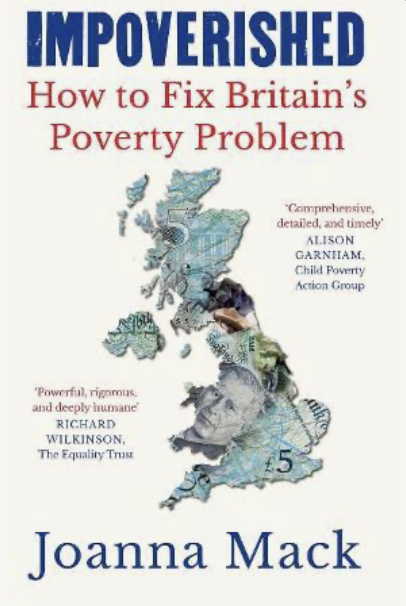
In my book, Impoverished – how to fix Britain’s poverty problem, I argue that that much of the current debate on tackling poverty is too narrow, focussing primarily on how to top up insufficient household income through means-tested benefits. This is not entirely surprising as the primary measure of poverty used by governments and policy makers, and the one seen in headlines, is based on relative income poverty; namely the proportion of the population who fall below 60 per cent of median income, adjusted using equivalence scales for household size and composition, either before or after housing costs. If the success, or otherwise, of anti-poverty polices, is based on this measure, the focus of policy is likely to be on raising household incomes at the bottom end; and in the cheapest way possible in the short-term, namely means-testing.
In my book, I argue that instead of conflating poverty with lack of household income, we need to look directly at the possession, or otherwise, of those items and activities necessary to maintain a minimum standard of living; that is material deprivation. Back in the early 1980s, I, along with others, developed a way of measuring poverty based on items and activities that the majority think essential to a minimum standard of living, what we called ‘socially perceived necessities’. Those in poverty are those who lack a range of these items, not out of choice but because they cannot afford them or access them.
In subsequent years, a range of low-, mid-, and high-income have taken up this approach and from 2024, the Department of Work and Pensions has included an up-to date list of material deprivation items for adults, children, and pensioners in its Family Resources Survey. This means that rather than just using income as a proxy for poverty, we can look at who lacks these items and ask why.
Clearly for items purchased on an individual or household level, household income is critical; but so is the items’ affordability. When the price of necessities escalates, as it has in recent years, this affects not just the poorest but those on middle, or even higher, incomes as well. It is at the root of the current ‘cost-of-living crisis’. The question becomes not just whether household incomes are adequate to cover these purchases but how the costs are set in the first place.
For many goods, this will be through a competitive market, but for others the market is far from competitive and dominated by monopolies, near monopolies or cartels. After, forty years of privatisation and deregulation, the stranglehold that monopolies and near monopiles have over key purchases is a striking feature of the British economy and lies behind the rising costs of key essentials, whether water, electricity, social care, transport, or others purchased through digital platforms.
In addition, while household income levels are critical to many of the items and activities which form part of a minimum standard of living, there are others where it is not. Publicly provided services free at the point of delivery, such as health care or education, constitute a significant resource for households. Other services, such as nursery provision, are free to a certain level of provision but not above; others, that are generally paid for, are either free for some groups, for example bus services for the elderly, or subsidised for the poorest, such as the social tariff for water bills.
The question therefore is not just whether such items and services are necessary but whether they should be free for everyone, or just for some, or for none, and, where there are charges, how these charges are set. For other essentials, such as tackling damp or an inadequate heating system, the cost of doing something about it for those who rent is not in their control. Here, the question is about regulation. Seeing poverty in terms of material deprivation shifts the focus of anti-poverty policies into new areas.
In my book, I set out a three-pronged approach to fixing poverty: tackling the cost of necessities, expanding the provision of free, or subsidised, services to new groups, and ways of ensuring income security for all.
Lowering the basic cost of living needs a sharp focus of those areas where there is no longer a competitive market. This would need a fundamental shift in economic thinking, undoing the extent of the extent of privatisation and deregulation of the last forty years. For many of the utilities, notably water and energy, there is a compelling argument to move them back into some form of public or local ownership, at least over the longer term. In the meantime, the pricing structure needs reforming. A reduced rate for a set level of use and with higher rates for higher levels of use would ensure everyone has affordable access and do not use it wastefully. In addition, the costs associated with environmental improvements and net-zero currently borne by the consumer need move either to general taxation or a specific fund financed by carbon taxes and the like.
And then there needs to be a focus on lowering housing costs, which have risen sharply at the bottom end of the market and are extraordinarily high by international standards. In the long term, building more social housing is an important part of the solution. In the meantime, there needs to be moves to control the prohibitive costs of private renting at the bottom end of the market, particularly in areas of high rental pressure such as London.
Next, there needs to be more emphasis on free, or subsidised, public services. This could include, for examples, expanding free or subsided public transport to new groups and making school meals free for all pupils and, most importantly, it would include the creation of both a National Care Service and a universal childcare system. This would lower the costs of living for all households, not just the poorest, and do so in a way that helps strengthen the bonds within a community and participation in it.
And finally, there needs to be income security for all. In my book, I set out reforms to the benefit system to transform it from its current minimalist approach targeting the poorest through means-testing into one which supports everyone, at various stages of their lives and with different and diverse needs. Means-testing both penalises saving as, above the most minimal level, these savings are deducted from your means-tested benefits and, because of the high marginal tax rates as means-tested benefits are withdrawn, discourages people from earning more through work, in particular moving from part- to full-time work or looking to progress in their work. Most importantly, the current heavily means-tested system has failed to make a long-term impact on poverty levels and demeaned and diminished the lives of its recipients.
Moving towards a more inclusive system would involve setting and maintaining the state pension above the means-tested pension credit limit, re-investing in child benefit, introducing targeted basic income for certain groups with specific needs and vulnerabilities, and redesigning disability benefits to ensure that the Personal Independence Payments actually cover the additional costs of living with a disability and, for those whose ability to work is limited, a guaranteed basic income introduced, which, to encourage participation in work where possible, is only gradually withdrawn if or when earned income increases.
I also suggest the introduction of a modern, contributory, insurance-based unemployment benefit to protect against the uncertainties of working life. Along with expanded childcare and social care and better training and support both for those out of work or for those whose current jobs are at risk, such changes could help establish a sustainable welfare system.
All this would require upfront investment, but this could come from changes to the tax system to increase the share of income and wealth redistributed from the group which has gained the most in recent years, namely those with highest levels of income and assets. In the long term, such an approach would be likely to bring savings to the Exchequer by enabling people to better able to participate in society, to work, and to lead healthier lives but, most importantly, it would start to tackle the impoverishment of many people’s lives in Britain today.