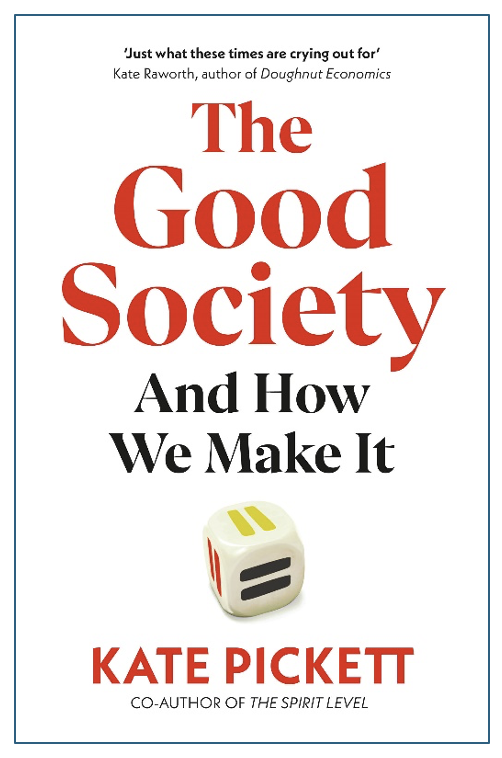
In my new book, The Good Society: And How We Make It, I set out to explore a simple but radical premise: that the most profound challenges of our time, from deteriorating public health to rising rates of imprisonment, a broken care system and an education system that fails to look after all our children, are not isolated accidents. They are the predictable symptoms of a single, underlying pathology: our unacceptable level of economic inequality.
For the Poverty Research and Advocacy Network(PRAN), this connection is vital. For too long, poverty has been treated as a standalone issue, a "lack of resources" that can be patched over with endless targeted and insufficient mitigations. But the evidence suggests that if we truly want to eliminate poverty, we must move beyond merely managing it and start addressing it as a root cause of our societal problems. We must tackle the structural inequality that creates and sustains deprivation in the first place.
Inequality: The Bedrock of Social Dysfunction
All of my past research on inequality, with Richard Wilkinson, spanning decades and detailed in The Spirit Level and The Inner Level, shows that societies with larger income gaps between the rich and poor suffer from a wide range of social ills. It isn't just that being poor is hard; it’s that living in a highly unequal society creates a ‘social evaluative threat’ that increases chronic stress for everyone. This stress erodes trust, damages social cohesion, and undermines the psychological wellbeing of the entire population.
In more unequal countries, we see higher rates of infant mortality, mental illness, obesity, and imprisonment. Conversely, in more equal societies, like those in Scandinavia, social mobility is higher, trust is stronger, and children have better life chances. The takeaway is clear: inequality is the "bedrock" on which our current society is crumbling, and tackling it is the most effective way to improve life for all.
The "Fantasy Society" is Already Here
Critics often dismiss the idea of a truly equitable society as an impossible utopia. To counter this, I use a concept from political economist, Andrew Simms, which I call playing Fantasy Society. If we build a "dream team" of social policies using real-world examples, we can see that the components of a good society already exist; they are just scattered across the globe.
We can look to Finland for a world-class education system that leaves no child behind. We can look to Denmark for a tax system that provides high-quality social care and free healthcare without financial stress. We can look to Costa Rica for pioneering environmental protection. These aren't fantasies; they are proofs of concept. They show that when we prioritise human wellbeing over raw GDP growth, a better world is entirely achievable.
Two Warps on Which to Weave the Transformation: UBI and Wealth Taxes
If we are serious about ending poverty, we need bold, systemic solutions rather than nibbling at the edges. In The Good Society, I propose two fundamental threads on which to weave a new social fabric:
Universal Basic Income (UBI): A regular, unconditional cash payment to every citizen. UBI provides the economic security necessary for people to flourish. It removes the humiliations and labyrinthine bureaucracy of means-tested welfare, which often fails to reach those who need it most. Evidence from pilots across the world, shows that providing this floor of security massively reduces anxiety and gives people the agency to make positive choices about their lives.
Wealth Taxes: To fund these transformative changes and reduce the corrosive gap between the top and the bottom, we must implement robust wealth taxes. This isn't just about redistribution; it's about rebalancing society to ensure that the commons – our shared resources and infrastructure – benefit the many rather than the few.
A Weft of Deliberative Democracy and New Institutions
Finally, we must adopt multiple forms of deliberative democracy, everything from citizens assemblies, participatory budgeting, new ways of funding our media and people’s primaries, to get all of our voices into political prioritisation and policy making. And we need some new institutions to help ensure that social policy evidence gets funnelled into political decision-making, just as we have NICE to ensure we get effective and cost-effective treatments in the NHS. If we do that, we’ll be able to avoid spending vast sums on the consequences of poverty, inequality and deprivation and instead be able to invest in sustainable wellbeing.
Conclusion: Lifting the Veil
In his famous "Veil of Ignorance" thought experiment, philosopher John Rawls asked us to design a society without knowing what our place in it would be – whether we would be born rich or poor, healthy or sick. He argued that any rational person would choose a society rooted in fairness and equality to protect themselves against the risk of starting at the bottom.
The Poverty Research and Advocacy Network(PRAN) understands this risk all too well. My book is an invitation to use the evidence at our disposal to build that fairer society. We have the blueprints. We have the proofs of concept. All we need now is the collective will to move from "policy-based evidence-making" to truly evidence-based policy. I hope you will read the book, see what you think, suggest your own alternative solutions. Together, we can build a society where no one is left behind, because we have finally addressed the root cause of our shared struggles.